Interview With Hanif Abdurraqib
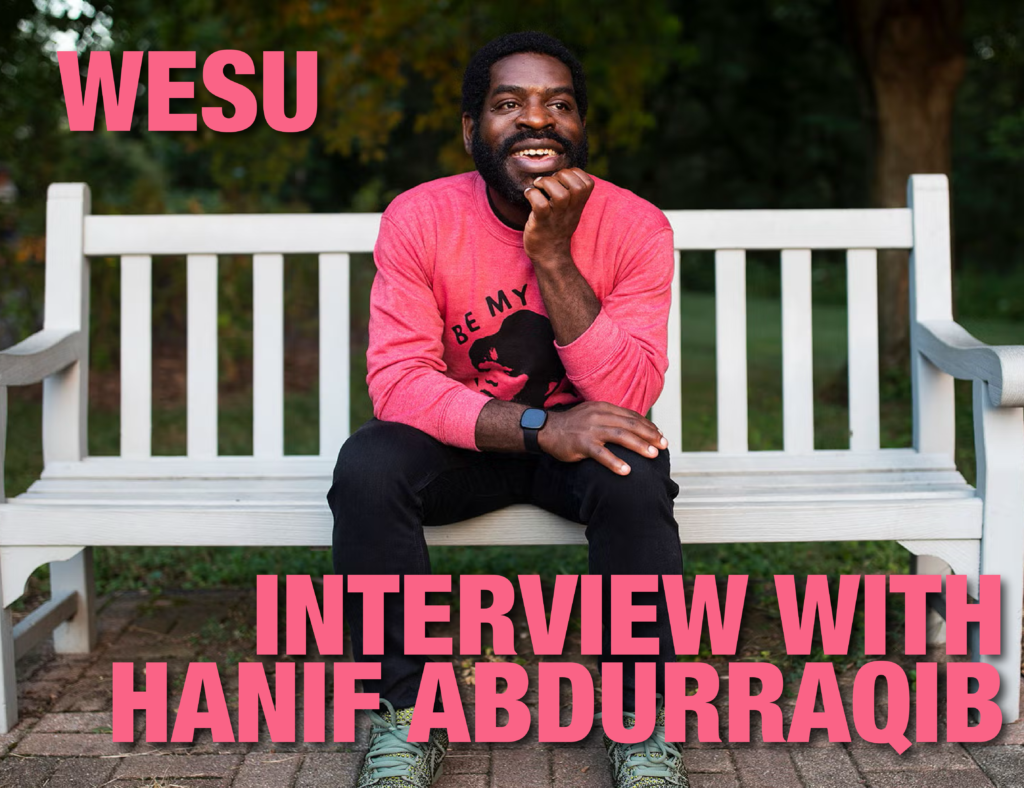
Hello! Jane and Isaiah here! As the music directors of WESU Middletown 88.1 during the 24/25 school year, we worked for months to organize what ended up as this interview. Life got in the way for a long time, but we are so excited to finally share it with you.
Hanif Abdurraqib is a poet, essayist, cultural critic, who has written for a variety of publications such as The New Yorker, N+1, Medium, and many more. Both of us were introduced to Abdurraiqib through his essay writing. Isaiah first encountered his work through Go Ahead in the Rain, a beautiful meditation on the legacy of A Tribe Called Quest through letters and essays. Jane first read They Can’t Kill Us Until They Kill Us, a collection of essays that ask questions about music, race, and place in America. We recommend any readers or listeners of this interview pick up any of Abdurraqib’s work. Hopefully you get as much out of it as we do.
About the interview…we didn’t plan to insert ourselves too much. After all, we were both here to listen to him. Despite that, in our time talking to Abdurraqib, we found ourselves sharing personal stories, anecdotes, and our feelings. Topics spanned from independent radio to grief, and often bridged the gap between those disparate concepts. Abdurraqib had a way of having us feel more like contemporaries than fans when in conversation. In returning to the interview, his genuine nature is obvious, living in the thoughtful, prose-like answers he produced to each of our questions. As a result, the interview felt more like a conversation with the wise parent of a lifelong friend—one you’ve known, but don’t necessarily know well—than a choppy conversation between an accomplished writer and two of his fans. We tried to capture that conversational nature in the transcription of this audio interview, but the audio will be available as well. We hope you enjoy reading or listening to this as much as we had making it.
Isaiah: And…recording.
Jane: Okay, awesome. Awesome. All right. We’re the music directors—I’m Jane.
Isaiah: I’m Isaiah—at WESU Middletown, 88.1 FM, the community/student co-run radio station at Wesleyan University. And today we have Hanif Abduraqqib, who is one of Jane and I’s favorite authors. And we’ve been planning this for a while and we’re really excited to ask him some questions and just get to know his thoughts on many things. And we just wanna thank you again.
Jane: Yeah, thanks so much for joining.
Hanif: Thank y’all. I’m glad we finally got to work it out. And y’know, I think, I’m so excited about and affectionate about the work that College and Community Radio does. And in a way I envy you both. When I was in college, I could not be a part of my college radio station. It barely existed, but it’s really wonderful to get to do this. So thank you.
J: Yeah, thank you. I mean, it’s our last two weeks at school.
I: Yeah, we’re both graduating in two weeks.
H: Oh really, congratulations.
J+I: Thank you!
I: This is a wonderful way to end our WESU career. Yeah, we’ve been- I guess we were gonna just start by saying how we came across your work.
J: Yeah, so I was a junior in high school and it was COVID in the spring. We were doing online class, and I was in AP English literature and my teacher, Dr. Lev, shoutout Dr. Lev, had like an optional book club and we read They Can’t Kill Us. And I remember reading it and being like, whoa, like essays can be really powerful and fun to read because you know, before that it was like, write an essay in class. And just, I never knew that until I was 16. Yeah.
H: Yeah.
I: My dad had been reading your work and he – I think I was probably 17, and when I first read Go Ahead in the Rain and that was similarly just, I had never, I had read essays before, I’ve always been a big fan of the genre, but I could see how you also are a poet in the way you write, the precision of language. And I was just kind of- I fell in love with your writing and just, we both love music, you know? Yeah. Music directors and seeing how you can write about music in a way that isn’t necessarily like music theory or just like pure analysis but something that is doing that and capturing a feeling and capturing the importance of maybe music in a moment or other things like that.
But I figure, this is more for me this part. I wanted to start by asking two, kind of silly, questions before diving in.
H: Sure!
I: I’m from Milwaukee- or right outside of Milwaukee. So a lot of the Midwestern references in your writing I always really appreciate and my grandparents live right outside of Columbus.
H: Ah, nice.
I: So one of the first is, I know you grew up practicing Islam and I’m not sure how strict you were with keeping Halal, but if you do have a stance, I would love to know where you stand on the Gold Star versus Skyline debate.
H: Ohhh. (laughs) Yeah, I mean, yeah, I was pretty strict initially but I’ve had, you know, I’ve wavered for much of my life. Now I’m pretty strict with Halal stuff but like I’ve had Gold Star and Skyline. I think they’re both bad but I do think skyline is better if we’re nor the reason because Skyline’s cheese is, like as an independent ingredient, I think Skyline’s cheese really does a good job to carry, you know, to carry the whole dish. (laughter) Because in the coneys, you know, like I think the coneys are maybe the most interesting part of the Skyline menu, like the spaghetti stuff is not for me but the Skyline coney partially because the cheese is a central character, I think is an interesting and delightful form. So, I am gonna say Skyline but- so I’m guessing your grandparents are from like- they’re around, they’re living around like the Cincinnati area?
I: They’re in Granville but we always have to drive through or maybe not through Columbus but I spent a lot of time in Columbus and just my dad went to Miami University. So he, growing up, my mom hates Cincinnati chili as I think a lot of people aren’t from-
J: I’m from New Jersey, so I don’t have the expertise, but Isaiah made our house like way too much Cincinnati chili. I was like, there’s chocolate and cinnamon in this?
H: Yeah, it’s like, sweet. Yeah, yeah.
I: Yeah. It’s weird. I just, I like to force midwestern things onto all of these east coast students.
J: (laughs) Go to the next question.
I: Oh, so my second silly question is, I know that you’re a big Columbus crew fan,
H: Huge, yeah.
I: And I would love to hear your thoughts on what I think is– it’s one of my favorite logos of all time because I think it is both great and horrible for many reasons– the old logo.
H: Oh, the construction guys?
I: I mean, I love it but I would love to hear your thoughts on it.
H: Yeah, yeah, I love the construction guys logo and I think it’s funny in a way because it seems like they, one, I like a logo that is maybe a little bit too literal and that is really a literal logo hall of fame where it’s just like, we’re the crew and here’s just a crew. Here’s a construction crew of guys.
J+I: (laugh)
H: But also, I think that logo looked the best on jerseys. I think it was a great logo for the jersey. And those jerseys, that era of jersey was the most interesting to me. And so, yeah, I don’t love the new aesthetic really at all. Like broadly, I’m not that interested in the new crew aesthetic, but, you know, I am kind of like an old school logo guy broadly. Like, I think I like the old Columbus Blue Jackets logos. I love the older Columbus Clippers logo. I’m a Timberwolves fan. I love the old Timberwolves logo. You know, I’m not a big- I know that there are a lot of people who are like, well, “everything was better when I was younger” and I don’t know if I’m that person, even though my work does dabble heavily in nostalgia I don’t think I’m like a hard-line “nothing new is good and everything old is great,” but I do love an old sports logo. I think there’s a maximalism to an older sports logo that intrigues me.
I: I agree.
J: Everything’s too sleek now.
H: Yeah, yeah.
I: The minimalism trend, I think, hopefully in my opinion, will die out soon. I always think of the old Raptors logo as like the just pinnacle of insanity, but also perfection.
H: Love that. Yeah.
I: Well, now that I got my silly question out of the way, we can start with…
J: Okay, yeah. My first question for you is: you’ve been going to shows for what sounds like most of your life. I’m curious, like, what about music journalism is compelling to you as a way to speak about your own life and comment on culture, and how you found yourself, like, gravitating towards that as a genre of writing?
H: I mean, I think centrally, I grew up on really vibrant community driven music scenes. I grew up on punk and hardcore scenes that were- the entire engine of those scenes were community in a very material sense, which means that you would go to the shows and then you would talk about the shows and then you would talk about the albums and you would talk about the merch and you would make zines and you would trade zines with people on different scenes and then you would get a window into someone else’s universe that you didn’t have access to. And so it dawned on me pretty early on that, you know, I spent so much time alone as a kid – I’m the youngest of four. I spent a lot of time alone with my records or my parents’ records. And then I found this way where I could make people or play a part in making people feel as though that which they were consuming was moving them forward or changing their life in some way as it was mine or we could compare notes on that. And so I was drawn to music criticism by way of thinking about it as a form of note comparison.
I’m very invested in the act of collective witness because it is all of us saying, I mean, you know, if we were all at a show together, we could all say, well, we experienced the same thing, but also not. We experienced this thing collectively, but it moved each of us in a different way, even if that way is slight, even if the differences are really minuscule. But the comparison of notes is where I think we get to have some depth in talking about what music does for us or what it can do for us.
And so that is the full reason why I think I got in the music criticism was I was like, here’s a real opportunity to spark a feeling that is a lack of aloneness to operate against aloneness by way of saying, “I saw this thing and you saw this thing and we loved it, but maybe we loved it a little differently and let’s figure that out together.”
I: Yeah.
J: Totally.
I: That is, oh, I love– my friend saw you talk at a book talk a few months ago and he said to me, he said, he speaks like he writes. And I was just, yeah. I think that actually leads really well into the question that I had wanted to ask after, which includes a quote, but it’s a quote that I always think of when I’m reading your writing.
And here I’ve prepared the question so I can say it without stumbling: In Fred Moten and Stefano Harney’s book, The Undercommons, Fugitive Planning and Black Study, there’s a quote that your writing always reminds me of. In the interview, Moten says:
When I think about the way we use the term study, I think we are committed to the idea that study is what you do with other people. It’s talking and walking around with other people, working, dancing, suffering, some irreducible convergence of all three held under the name of speculative practice. The notion of a rehearsal being in a kind of workshop, playing in a band in a jam session, or old men sitting on a porch or people working together in a factory, there are these various modes of activity. The point of calling it a study is to mark that the incessant and irreversible intellectuality of these activities is already present.
And to me, Moten’s description of study here has always struck me as something that your work is really invested in. And I know that Jane first encountered, like they said, your work in an academic setting in school. So I wonder if you envision your work as kind of a reflection on this type of study that Moten describes. And I’m curious to know if you see any kinds of possibilities offered in the type of work and the type of writing that you’re doing?
H: Yeah, that’s such a kind, thoughtful question, especially I mean, Moten is such a hero of mine and many of ours. I think, you know, I’m someone who does not have a great or really any kind of existing relationship with say academia or, you know, I didn’t study writing in college, I was bad at school, all these things, but I do think that so much of the engine of my living is to offer close attention to the world, and to be increasingly aware of the fact that the world as it exists and as it has existed for a long time does not necessarily deserve our close attention or close affections, you know? There’s a way that I think, especially now I would say, we are being conditioned to turn away from the offering of close attention.
And so even to say, to give close attention as a form of study, but particularly and especially what is being asked of one’s close attention has to be something more than holding something in your palm and admiring it yourself. If you can offer your palm out to the world and gather others around and say– You know, I love Ross Gay’s “Poem to the Fig Tree on 9th and Christian” because the tree itself, you know, nothing really happens in the poem, but then again, everything happens in the poem. I don’t know if either of you have read that poem, but it is a, the speaker sees a fig tree and then pulls figs off of the tree and gives them to people who are standing around and then more people gather and then more people gather. And through that function, through that action, the tree becomes a vessel for something beyond its function.
And so what I’m doing, I think, if like maybe study can be projected in this way, what I’m doing is saying, I would like to afford a level of attention to the world, a level of close attention to the world so that through my close looking, something transforms into a different vessel for a purpose– it has a different purpose, a more useful purpose than just our own kind of whimsical consumptions. And that does require a level of rigor that I hope shows up in the work, but that begins in my living.
I: Absolutely
J: Yeah, I’m always amazed by your attention to detail and just ability to recall moments with such clarity, like when you’re at shows and– I was reading that essay about the– I forget the name of the band, the emo band that had a 10 year reunion.
H: Oh, Cute is What We Aim For.
J: (Laughs) Yeah, yeah, and just like, it felt like I was at the show and that guy at the end turning to you and being like, “man, it’s like, not like when we were kids anymore.”
H: Yeah.
J: Yeah, I think you really beautifully captured that.
I: Yeah, I agree. That was more than I could have hoped for in an answer to that. I really appreciate it.
J: Yeah, I have another question also from They Can’t Kill Us, in your essay, “Searching for a new kind of optimism.” There’s just so many parallels to what we’re experiencing currently and your quote, “I’m hoping mostly that we all get better at wishing on the things we need, even in darkness.” I’m just wondering how your ideas have evolved around optimism because as many parallels as there are to 2016, you know, a lot has changed.
H: A lot’s different, yeah. I don’t think I’m an optimist. I mean, I never have been, but I think that what I am especially now is someone who is propelled by honesty, and I get asked all the time, like “what are you hopeful about?” But I’m actually not hopeful about anything or not hopeful about much. I think honesty is a real function of– I think hope as it exists in the American lexicon is something that is often used to obscure the truth about what we are collectively and individually experiencing by saying, “I am looking forward for the thing that might not arrive” and if it does, we are a society that has enriched itself on gambles. And that has bled into, I think- even the most radical political imagination when I think the foundation of any forward movement is honesty.
To say “this is what is happening in the world” and “this is who is impacting beyond myself” and more importantly to ask the next question of, here is perhaps something I can do beyond that or it’s something I can do to create a slightly different world or to change, to ever so slightly alter the machinery of the world that I am in. And that takes honesty more than hope. It takes ambition more than optimism. I’m not saying that I’m a pessimist or that I’m– but I am saying that I am deeply intertwined with the ache that my neighbors and loved ones feel and how that ache impacts me and how it magnifies my own aches. And if there is one thing that despair does for me, despair puts me in a position where I am saying, “there has to be something other than this.” And that to me is not even a hopeful statement. That is a statement that says, “there has to be something other than this because people will not survive. People are already not surviving.” And so I think the one thing that I do, find myself turning towards with some level of eagerness is that I do think that despair allows for innovation; emotional innovation and creative innovation in how we attack the very large problems and the very small ones and stitch together enough days that make for a life worth fighting for.
J: Yeah, wow.
I: I’m curious, this is a little off-book from our [script], but based on what you just said, another thing that always sticks out to me in your writing is kind of an idea of… The example I’m thinking of is like beauty, not as something– things are not necessarily beautiful because they are, but because they have a capacity to maybe be beautiful. And I might be wrong here, this is I think similar to what you were saying earlier, we take different things away from the same pieces of media or writing based on who we are. But I think also when I read, I think maybe things aren’t inherently, ugly, it’s the capacity that they can be ugly and we kind of have to take those in flux. I’m wondering, do you have thoughts on that– I’m kind of realizing I’m thinking about your work in real time, but.
I: Yeah, I mean, I think often about the fact that… there’s a whole scenario in my mind where… um… Do y’all know who Tom Doud is?
I: Tom Doud?
H: Yeah.
J: I don’t think so.
H: Tom Doud is a person who– he was a recording engineer for Atlantic Records and he, like, innovated and somewhat pushed forward the multi-track recording process, which means that he is, like, highly responsible for engineering and altering the sound of music. He was the person who produced Ray Charles, what I’d say and said, we got to cut this into two parts. He captured, you know, he, like, recorded John Coltrane, he engineered Derek and the Dominoes and so much beautiful music that he is responsible for – Diana Ross, Otis Redding, Stand By Me is a song that he’s partially very responsible for. He is also responsible for the atomic bomb to some degree. He worked on the Manhattan Project when he was in the military and he, you know, he has the same brilliance with which he used to innovate recording and altered American music is the same innovation he used to create or play a role in creating the atomic bomb, working with the Manhattan Project.
By that, I mean, there’s a real function of the idea that at least internally I know that there are things in my heart and mind that show up in my work that people love that I can use for, you know, I mean, in my work, I talk about the times in my life where I’ve been a very committed liar, where I’ve been a less than good person that could build narratives that weren’t necessarily true with a beauty that turns people away from that binary true or not question and turns them towards beauty.
Now, there’s a reality where I have to ask myself, is that serving the best function or is it serving a better function to tell a story that is true of my people, of this place I love, and to ornament it with the kind of language that also emotionally affects people? Tom Dowd had asked himself this question of, “do I wanna keep building towards this destruction or do I wanna make some–?” What I’m saying is internally the same tools that we use to make weapons, both literally and metaphorically, are often the same tools that we use to make beauty that people bask in. And so I think it is both up to the maker to find some level of responsibility for that. And it’s also up to us as interpreters of art, of writing, of music, to ask ourselves what– or just like interpreters of the world as it arrives to us– to ask ourselves, what is this, what is that which we are consuming, igniting within us and what part of us is it serving?
I: Thank you. I mean, thank you for even entertaining that kind of question I tried to formulate on the spot, but that was, yeah, yeah.
J: (To Isaiah) Did you just…?
I: (To Jane) I think we should move that question later because it’s more… I think I’ll go for this one.
J: Yeah, this is kind of falling in line with what you were just speaking about. So I just finished my printmaking thesis, and in revisiting your work, I’ve been thinking a lot about my own efforts to capture ephemerality and kind of my own experience and collective experience. I actually made prints of mosh pits, people moving and sweating and kind of these fleeting moments that you hold in your memory and your body. And I asked myself, how can I embody and immortalize those moments? And for me, it was through printmaking, but for you, I was wondering how… sorry, I’m going off from the question. Where does your desire to capture these types of fleeting moments come from and do you find that the essay or the poem is able to capture that in a way that other mediums lack for you?
H: Yeah, well, I mean, the biggest desire is that I treat, I try to at least, I try to treat memory as a privilege. I try to, you know– I’m in community with elders, which is beautiful often. And there’s community elders in my neighborhood. I visit them, I spend time with them, which means that I get to watch or I have access to moments where I’m watching people’s memories fade in real time. Right, it’s real time fading of memory. And that’s a bit devastating, I think.
And so that pushes me to a place where I am, I think, tasked with and eager to treat memory as something that is a privilege. And I don’t just mean a privilege in terms of, I am privileged to be able to remember things or I am privileged to be able to– but that not all my memories are born out of trauma. And so I am oftentimes trying to isolate and expand, to isolate a moment and expand it so that it ties into a greater web of my living. Because oftentimes I’m not writing about things like right after they happen, right? I’m looking back on something after having lived it and having had distance from it, sometimes great distance from it. And I’m writing into it in a very specific way. And what that’s doing for me is it’s saying, “How can I make sense of my constant becoming? How can I make sense of the version of me that I am continually turning into and turning into and turning into?” And so that, you know, that is really vital for me. And so that’s, you know, that’s massively important. And so that is how I relate to memory.
And the other thing is I just tend to think that it is thrilling to say, “I didn’t just arrive to a place, I did not just arrive to like an emotional or mental revelation or series of relations,” or “my heartbreak did not just emerge out of nowhere,” you know, or “my relationship with grief that is ever evolving into some urgent and aware, it all came from somewhere.” And it’s important, I think for me, to be honest about that. Yeah.
J: Absolutely. (To Isaiah) You want me to?
I: (To Jane) I think you should ask that one.
J: Yeah, I guess kind of going off of that, talking about grief, I’ve been experiencing a lot of grief this year: personal grief, grief for the world, grief for the way that time is passing– I mean, we’re leaving school, it’s, you know, lots of things transitioning and happening. I don’t really know how to talk about grief. I have been at a loss for words of how to just explain how I’ve been feeling. And I feel like you talk about grief so poignantly, and I was wondering how you feel you kind of grown to be able to speak about grief in this way.
H: I think in some ways, my relationship with grief is one that is tied to tenure. By that, I mean, my understanding of the fact that every year I get to live is wonderful. And also every year that I survive is another year that presents with me the opportunity and the reality that I’ve– you know, it’s rare that I make it out of the year without having lost someone. And so I am in some ways trying to build a generous relationship with grief, not only for myself, but as a blueprint to the people who love me and who are close to me, so that there might be a world where they can learn to mourn me well when I’m not here.
And I often think about the challenges of honoring the full self of a person who is not with us anymore. Because time is a real enemy of our tactile grieving. By that, I mean, when someone– I like to think of this as, you’re walking on a very long road with someone. And then they die. So they are moving forward without you to a place that you cannot yet get to. And as time passes, the perhaps cruel thing is that they get smaller and smaller, but they never fully go away. You can still see them, but their voice that carries back to you might become a little flimsy when they call your name or the way their eyes look may become a little blurry to you. You have to squint to see it.
And so what grieving is for me in some ways is pulling together all of those things that I can still hold on to and building a kind of haphazard monument to a person I love, even if it is just to say, “I don’t remember my mother’s speaking voice some days because she’s been gone so long, but I vividly remember her singing voice. And so I will build a monument to the song I remember her singing” or my pal Tyler. I was thinking about him the other day because it was the 20th anniversary of Fallout Boys from under the Cork Tree record, which he loved deeply and I did not love when it came out. And he and I would fight about that album all the time. And I listened to it now. I put it on the other day and I remember there was a song on it that I found myself loving that I did not love in the past and I thought, “This is actually not me. I am loving this song through a person I loved. I had the privilege of loving.” And that, I think, honors grief in a way that I can live with. One that says, I’m presenting this person, I’m not just building this monument for me, for myself. Yes, I am in some ways, but I’m also building it in my work so that you—the reader, the listener, whomever—can come by and witness it. And now you know a little bit about this person I love and through you knowing about them, you might have some small affection for them that carries on beyond me.
You know, like someone, I saw someone on Booktour this year who had like a line from “Fall Out Boy Forever,” the essay tattooed on them, which means that in some strange way, Tyler lives on through that person as well. So I’m broadening the scope of, I’m broadening the scope of legacy of the people I love. I’m broadening the scope of their afterlife so that I perhaps feel less lonely in grieving them. And that, I hope, sets a good blueprint for how I would like to be grieved when I’m no longer here.
J: Well, that is so beautifully said. I– it made me think about– I forget who said this to me, but I lost my grandma at the end of last year and I was getting really sick of people saying, “oh, it gets easier” or, you know, just the whole idea of things getting better. And someone said to me, grief is like a little pit inside of you that doesn’t necessarily change sizes, but you grow around it.
H: Right.
J: And I thought that was beautiful in that, you know, even for me, I’m not tangibly writing about my grief for making work or music about it, but I do feel like I can put my love for my grandma out into the world through just like very little things, things that she taught me how to cook, just be a loving person. And yeah, yeah.
H: Yeah, I mean, it does not need to get– I think like that’s the thing, right? I think when we hear that it gets better, that is a normal thing to say. And I think a comforting thing to say perhaps, but it also actually, like, does not need to, you know, (laughs) like functionally, it does not need to get better. And that is– it needs to get different perhaps. It needs to get more malleable or we need to get different and more malleable and it alongside of us is required to, but I actually don’t need it to get better. I actually prefer that it doesn’t get better in the traditional sense if we’re using the binary of better or worse. You know, I missed my mother as much today as I did the day– the morning that she died, but it is a different kind of, it is a different kind of missing and it takes a different shape. Absolutely.
I: I think I about, I mean, probably about six months before you lost your grandmother, I had lost my grandfather. And I remember a moment where it was most potent to me was when I heard– he was a very serious man, but he loved Aerosmith. And I heard “Dude Looks like a Lady,” which I always have thought is a ridiculous song.
H: Truly, yeah.
I: Yeah. But I heard it and there was like, like you were just saying about your friend Tyler and the Fall Out Boy song. There was a part of me that was like, it’s wonderful that my, like, kind of grumpy grandfather loved this wild song and I love that song for that.
J: That’s really funny, I didn’t know that.
I: Yeah, it’s kind of, it’s very, very beautiful how people live on through those things. I don’t want to do too hard of a pivot (laughs) but I do feel, this does actually weirdly, I think relate not to the loss of a person, but to the loss of– you know, different types of grief. As I said earlier, my grandparents live right out, or in Granville, which I guess is like 45 minutes an hour outside of Columbus, but we would drive, and every time we would drive to my grandparents house, the moment we got within range of CD-101, the alternative rock station in Columbus, we would always listen to it. And that was like a big part of my childhood. And I know that they closed their doors about a year or two years ago.
H: Yeah, yeah. That was a bummer.
I: I’m wondering though, like they were an incredible station.
H: They were.
I: I’m wondering just regarding radio and that sort of, kind of both radio being a, a dying medium, but I’m wondering how that kind of formed the way you both listened to music or find music or experience it.
H: Yeah. Well, patience is really the answer there. Or, the patience is, like, the huge overarching answer because I grew up making, like, cassettes off the radio. Y’know? That’s how I first engaged with music, at least on my own. And I had older siblings. I was lucky to come up in the early 90s, early mid 90s because it was a really golden era of college radio, and I had older siblings who were in college at the time. And so they would come back with just tapes they recorded off the radio. The first time I heard it smells like Teen Spirit was on like a cassette tape that had been picking up like OSU college radio, Ohio State College radio. So patience is the answer. I used to just wait by the radio for hours for one song, y’know? cause that’s what you had to do. And you could sometimes call in the radio and request the song, but that didn’t guarantee it was gonna get played and it didn’t guarantee when it was gonna get played, you know, that type of thing. And so I think that I got very comfortable with just sitting around waiting for something to come to me, that I, something that would change my life, like something musical that would reshape me.
And I think now, I mean, a big defining thing about my life now today is that I spend so much time seeking out new music and looking for new music and listening to new music. And a big part of that—a massive part of that—is because I don’t want to surrender the idea that I might hear something that will change my life.
J and I: Yeah.
H: You know, when I was young, I remember hearing, like, Sleater Kinney’s “Call the Doctor,” the song, for the first time in feeling very vividly as, like, a 12 year old that something had shifted in me. And I had that experience so many times growing up, you know. I had that experience in the 90s and the 2000s and the 2010s. I don’t want to surrender that. And I also think the more music that gets released, the harder it is to find that moment, to dig for that moment. However, because it is harder to dig for that moment, when it arrives, it feels even more transcendent. I remember hearing, and I had heard their music before, but specifically the song Hearing Black Belt Eagle Scout’s “My Blood Runs Through This Land” for the first time was mind-altering. And yeah, I had to dive into like 10 albums I didn’t really love to get to that one. But I don’t, you know, it’s a worthwhile endeavor, I think. It’s a massively worthwhile endeavor.
And so the radio shaped my listening because it told me you are not always going to get exactly what you want. But if you wait for a little while, something will arrive to you that might change you. And that’s still the way I approach music discovery.
I: Yeah. I think, I mean, I don’t know if, I don’t want to speak for Jane. Jane and I are best friends, housemates, we’re in a band, we have a radio show, all of that.
J: Yeah.
I: So I mean, I think I had that recently with, I got into emo, yeah. I don’t know if you’ve ever listened to Jejune. They were like a–
H: Yeah, yeah.
I: I had never listened to them before and none of their stuff is on Spotify. I don’t even remember how I found it.
H: No, that was like a tough… that’s like a wild because they were just kind of on a boss. They were on, they’re from Boston, right? They came out of Berkeley and shit. Yeah.
J: (To Isaiah) You said it was an Emo website database, right?.
I: Yeah, I found this website called, like, something’s basement (It’s actually called Sophie’s Floorboard. Close enough) and it’s just a kind of just this huge file database of all of these emo bands that a lot of them never put stuff on streaming because they just released one album and broke up. And I’m probably 20 years late– not 20. I don’t think I was going to listen to emo music when I was three, but I’m way later to the emo wave than I wish I would have been.
H: Yeah, yeah.
I: The song Coping with Senility, I heard it and immediately I was like, this is one of the best songs I’ve ever heard.
J: It’s transcendent.
I: And we are–
J: We’re covering it.
I:. Our band is playing it at Spring Fling at Wesleyan in four days and we’re covering it. And I’m just– yeah.
H: Very cool.
I: Yeah. When you were talking, I just immediately thought of it and said that was my moment like seven months ago of hearing that song and just knowing, “oh, there’s kind of the moment before hearing this song in my life after it, where I listen to it constantly.”
J: Yeah.
H: Yeaaah. What was the name of the first album? Junk? Junk is like one of my favorite emo debut albums of all time. So that’s, yeah, that’s incredible.
J: I mean, I feel like everything you said really just encapsulates the experience that I’ve had—I don’t want to speak for Isaiah—but that I’ve had as a music director at the station. Like we go through so much new music. We get thousands of emails. We get some physical copies sent to us. And it really is just all the more special when you find something that you’re like, “whoa.”
I: The Fantasy of a Broken Heart album. That blew me away.
J: Yeah, yeah, yeah. Yeah.
H: Yeah. I mean, I feel like that’s probably the part of… You know, it’s hard to figure out how to sift through what’s worth your time and what’s not. But I sometimes think like– I don’t know. I’m someone who loves music. A lot of times I’m like, it’s not like I’d be doing other shit anyway. You know, like music’s going to be playing anyway, so I might as well experience something that’s new to me that could change me potentially.
I and J: Yeah, yeah, totally.
H: What’s the name of your band?
I and J: Slore (laugh).
H: How do I? What is it? How do you spell it?
J: S L O R E.
I: We’ve got an album in the next… month? Two months? (Current Jane and Isaiah: That was wrong. It will be more like late August.)
H: Really?
I: A single coming too. Our first single is coming out the day of Spring Fling.
J: Yeah, Thursday.
H: I’m excited. Will you send it to me via, like, email when it drops?
I: Yeah we would love to send it to you! (laughs)
J: Yeah, yeah, we actually put a playlist together for you that we’ll send after the interview. And once it comes out, we’ll, like, add it there and everything.
I: But yeah, we… yeah, we would love to send it.
J: Yeah that would be awesome.
I: Yeah, we have a few– Wait, sorry you have one more (to Jane).
H: Take your time. I’m really not doing much. So y’all got it, take your time.
I: Yeah, we’ll just run through the last few. Jane’s got like another, you know, thoughtful one. And then we’ve just got kind of random, just fun music questions that we would love to hear your thoughts on.
H: For sure.
J: Yeah, so you write about your experience as a Black man at concerts where there are often few to know POC. Well, you know, obviously in certain scenes, more than others. I was wondering if you’ve noticed any shifts in kind of audiences, especially in those genres where historically POC are less represented. You know, you talk a lot about invisibility at these shows and in these spaces. And I don’t know if it’s just from my experiences. I mean, I grew up in Jersey, so I was going to shows in Philly, some in New York. I feel like even in the past decade that I’ve been going to shows, I’ve seen just a pretty interesting shift in audiences. And I was wondering what your experience growing up in the Midwest, your thoughts around that?
H: Oh, yeah. I mean, truly I feel very fortunate that I’ve gotten to be around so long that the like very literally the tone and vibe of audiences that shifted now, I will say too, like when I was coming up on the punk scene to some degree, like in Detroit and what not, those are mostly Black scenes. You know, those were like, extremely Black scenes that I think really colored for me what it would be like, what it was like to be in community, other Black folks specifically and protect each other and look out for each other. But now I’m so heartened by the fact that I see so many young folks, young Black folks, young folks of color, who are kind of like the predominant audiences at a lot of punk and hardcore things. And it also reflects on the stage, like it reflects what is being presented on the stage. And that is also just like, massively heartwarming to me as well.
And so, yeah, I think these shifts feel uniquely important. And I think that also means that we’re not just seeing again, an evolution and who is coming to shows or who feels safe at shows. We’re also plainly seeing an evolution in, you know, who is making music and what the music is sounding like. And that to me is a thrilling experience.
J: Absolutely. Yeah. When I was writing this question, I was thinking specifically about, kind of, this new wave of screamo and skramz. And yeah, I feel like the shows I’ve been to, it’s been predominantly people of color and young people. And it’s just really cool to see people that look like me up on a stage.
H: Well, for sure. For sure. You know, I think there were definitely bands to be clear, like when I was coming up, that were not all white, especially in the Midwest, but to just see the dominance of that in the way also that I think the innovations and shifts around genre and what genre is or can mean feels incredibly important because you’re getting a lot of young folks who came up. You know, like I’m 41, which, you know, so like I go to shows and they’re like 22 year olds on stage who grew up at a very specific– 22 year old, like black kids from anywhere. You know, this isn’t like a hardcore band, but a band I love that is now broken up as a band called Black Star Kids. You know, just these–
I: I didn’t know they broke up!
H: Yeah, it’s unfortunate. They broke up last year, like late last year was a bummer. It’s a bummer. Long live Black Star Kids for real. Because to me, they were a perfect encapsulation of what I’m talking about, where you got these young black kids from Kansas City, Missouri, who grew up listening to, like, truly everything.
I + J: Yeah.
H: You know, who grew up listening to a lot of shit, and you can hear it. And there’s this mutation, there’s these mutations happening where it’s like, yeah, we’re kind of a pop punk band, but we’re kind of a soul band, but we’re kind of like a, you know, we’re kind of a little bit of like a radio country band. All of this stuff pushes us away from these hard line genre delineations that really, I think, allow for a kind of freedom and a real possibility.
I: Yeah.
J: Totally.
I: I mean, I mean, along with me being super late to emo, I was super late to hardcore and general punk, honestly, I think, because I grew up listening to, like, R.E.M. and Bruce Springsteen through my dad. But Jane showed me my freshman year here, Soul Glo.
H: Oh, yeah.
I: and that was the first punk I dove into. And I, again, like a song where I remember hearing, like, “Driponomics” for the first time and saying, “I don’t know what genre this is, but it is incredible.”
H: Yeah.
I: Yeah, I feel like we talk a lot about the kind of, how do you define these things? And it’s tough now, but in a very beautiful way.
J: There’s so many like micro genres.
H: Yeah. Yeah. I mean, I tend to think that I am someone who has a very wide range of understanding about music (laughs) and has heard a lot. But I think as I spend more time with younger bands specifically, what I’m realizing is that, like, we’re kind of pushing past the frontier of genre, which means that anything can be anything, you know, and I really love and respect that. Totally.
J: Totally.
I: Well, I think maybe I think an example of that, and this is one of our shorter music questions, but we’ve been following your just writing for a while, as we said, and the past three years, we’ve both been looking at your albums of the year list. And this, this past 2024, we were like thrilled to see MICHELLE being number one.
H: Yeah, because a couple of them are from Wesleyan, right?
I: Yeah, Jamie Lockard is one. (To Jane) Is there another person from?
J: Yeah, Jamie, she’s like my good friend’s older sister, yeah.
I: Yeah. But I guess we wanted to– Yeah, they played the Garden Fest concert, our freshman year, which our old band opened that which was crazy.
J: Yeah, that was crazy.
I: It was, it was MICHELLE and MAVI, which was wild.
J: Yeah.
H: Whoa, that’s a cool lineup. I’d be into that.
I: It was so incredible.
J: It was great.
I: One of my favorite concert experiences. Um, but we would love to hear, I mean, I think, and the Wesleyan community would love to hear you kind of just rave a little bit about MICHELLE, because they’re, they’re such an interesting group and they make such fun music.
H: Yeah. It’s funny, the first time I heard MICHELLE was on a college radio. So I used to, um, every now and then, if I had time and I was like in an airport, which is a lot of my life these days, I would just stream like an NYU college radio show. I don’t even know it was just like someone’s, you know, some student with a radio hour who would play whatever. And they played Michelle. This is maybe 2020? When I was doing that a lot more, 2019 because there was so many virtual college radio hours. And I heard Michelle and I was so taken aback by the songwriting. And I think it is challenging to write catchy… they’re a pop group. I think it’s fine to call them a pop group by definition. It’s hard to write pop music that catchy for that many voices, I think. That many voices that all sound different. They all have a different approach to how they take on these songs vocally. And the way that they are writing these songs, these kind of really layered, beautiful pop songs and very danceable pop songs, it is doing so, not at the expense of the kind of polyphonic experience of listening to MICHELLE. It’s really leaning into it where it’s like, “you get a verse” and there’s a real, there’s a real like philosophy of almost like sonic equity in the group which I think would be the undoing of a lot of groups that aren’t as deft and thoughtful about the songwriting practice. Because what’s actually happening around a lot of those MICHELLE songs is that there’s a real coming together in the chorus that earns out whatever else is happening in the verses. And you actually don’t spend a ton of time in the verses, you know? The verses are more like miniature mission statements in the choruses are where those mission statements earn themselves out into kind of an emotional action. And that payoff just does not get any… you know, that payoff is so rich over and over. And so I, yeah, I don’t ever… you know I’ve seen a ton of concerts in my life, like a whole lot, and so I don’t really get to… you know, there was a point in my life where in my late teens, 20s, I was going to like five shows a week type shit. And so I don’t really… I’ve just seen so much it takes a lot to get me out the house to go to a show these days. And I don’t want to– I’ve just seen a lot, but I drove to Tennessee to see MICHELLE because they weren’t coming close enough to, you know, they played in Nashville and that was the closest they were getting to Ohio. So I drove. I drove five hours to see them at the Blue Room.
And that was such a beautiful experience and one thing too I’ll say about them: talk about being in a room for a live show. Like I was so heartened by the audience there, because the people who were there were really there. I mean, the Blue Room’s not a huge venue, it’s like 150-200 people. It was packed and everyone there was so into what they were experiencing, you know? I’m not a big filming-a-concert-on-my-phone kind of guy, but I also don’t like, grumble when people do it. I get it. But I did, I could not help but notice that so few people– like everyone was just so engaged and it was actually a different show than I expected, like they dance around a lot, you know. It’s like a very, it’s almost like giving, you know, like, 90s pop group in a way. And I was so enthralled by that– they are just having the time of their lives on stage. It seems like it was one of those moments where the music as you’re imagining it– it comes to life on the stage exactly as you would imagine it would. And that’s so gratifying. That so rarely happens.
J: Absolutely. That’s- that’s how I felt when they played. I mean it was like night, it was kind of cold. It was outside.
I: There was what, like 40 people there?
J: Yeah, but it was like, it was just joyous like everyone was having so much fun.
H: Yeah.
I: They have the like… it feels kind of like a pop anthem whether you’re in like a big, you know, show or you’re just listening to it in your headphones which I don’t experience a lot with with other musicians. Something about their music kind of encapsulates that whenever you listen, which is, yeah, they make great stuff.
H: Yeah.
J: (To Isaiah) Do we want to ask one more music one and then wrap up?
I: (To Jane) Yeah these are pretty quick. (To Hanif) I mean, it’s up to you.
H: Yeah, yeah whatever y’all got.
J: Sweet.
I: I can do this one.
J: Yeah.
I: I mean, you did kind of touch on this, but I would love– when you talked about the Fall Out Boy song, have you ever had, and I’m talking both ways, a full turnaround on an album or artist like went from loving it to just I can’t do this anymore, or didn’t get it at all or just outright disliked it to, you know, one day it clicks and, you know, oh I get it now. I’m wondering, cause those are some of my favorite moments.
H: Sure. Yeah. Yeah, I mean that happens all the time, particularly, I mean, I grew up on the you know, emo pop-punk scene so a lot of that shit just, quite frankly, has not aged well and has left me feeling– and it shouldn’t, I tend to think that like a lot of the shit we love maybe should not functionally age well, because it is a sign of us as listeners, as you know we are perhaps aging beyond what we loved when we were young and so that’s a part of it. But yeah, I mean all the time I think like, you know, almost monthly at this point, and I tend to think– I’m big on revisiting things that people love.
I: Yeah.
H: I think at the core I want to love what my friends love, or at least, I want to aspire to love what my friends love even though, you know, that’s a sometimes impossible task, but it’s worth reaching for, and so I tend to feel like… yeah, I mean, I’m trying to think of a great example recently… And I think that the best and most gratifying examples for me work in the direction where, “I did not love this and now I love it”, I think um– ah, they just escaped my mind. There’s a Kinks record, I like the Kinks a lot, but I don’t um… and I like a lot of the Kinks albums– one I did not like at all for years, and years, and years was Arthur; Arthur or the Decline and Fall of the British Empire, and it’s just too–you know, I’m not a concept album guy. I’m just not like I… It depends on what you’re asking me to understand.
J: Right. Yeah.
H: For example, if we are to believe the Black Parade by My Chemical Romance is a concept album, which it certainly is, that… I can follow that path. That’s a path I can follow and enjoy and project my own things onto easily, but like, I don’t know. Some of the like Coheed and Cambria shit, I’m kind of like, just give me the songs like I don’t know what the fuck y’all are talking about, you know. And so, Arthur is one of those albums where, you know, it’s this massive story about a guy watching the fall of the British Empire in the late 60s, and I grew to love it because I think as I got older, I tuned more into this hunger for that kind of lens of power, like, being critical of power through that lens. I tell you what, there’s a lot of albums that came out in the 90s that I feel this way about, and I can easily massively pinpoint them and tie them to something, and what I can tie them to is the fact that I had older siblings, and I got to a point where, for better for better or worse, my impulse was to not love what my older siblings love. And that put me at the mercy of, you know… because when you start finding and discovering your own shit, you know, you kind of want to not love– so like Mezzanine by Massive Attack is an album that I for some reason rejected just because one of my older siblings loved it deeply, or like, Music Has The Right To Children by Boards of Canada, you know, all of these… There’s all of these things that, where it’s like, I would have loved this album, had I not been so stubborn about my, you know, my love… you know, My Bloody Valentine– I was so resistant to My Bloody Valentine for so long, not because I even knew… I didn’t know shit about them as a band– in like 1998, what I mostly knew was that there were like older kids on my scene, who would not stop talking about them.
J: Right. (laughs)
H: And I was like, well, I wanna love something on my own. I don’t want to be, I don’t want to have this pushed on me. I want to love this as I love it.
J: Uh huh.
H: And so yeah, there are bands like that. Portishead is another one, these kinds of bands that were held up in this way. You know, I was really on these journeys of self discovery, particularly in the late 90s – early 2000s when I could, in the high like Napster era type shit, where I could find my own music. And I found, like, Cocteau Twins and like, Neutral Milk Hotel and Slint. There were these bands I massively loved. You know, there were these bands that I, and I did not want any interruption of that by anyone telling me like, you know, here’s another band you should love because I say you should love them.
J + I: Yeah, yeah
H: So there’s a stubbornness that informed that that allowed me the real virtue of like in the mid 2000s, re-finding an album like My Bloody Valentine’s Loveless and being like this is the coolest thing I’ve ever heard.
J + I: Yeah, yeah.
H: And getting to do these, kind of, corrections. I really love that.
I: Yeah.
J: I feel like Isaiah and I have that dynamic all the time. Isaiah’s like, “I found this song and you have to listen to it!”
I: Like your shirt. (laughs)
J: What? (Jane is wearing merch from the band The Garden)
I: I was a Garden denier for years.
J: Oh yeah Isaiah hated The Garden.
H: Oh, yeah.
I: I’ve come around.
H: Yeah, I, um, I could see that I mean, they’re kind of a– I feel like they’re a polarizing band.
J: Yeah.
H: For me even, um, because like I think about, um– Mirror Might Steal Your Charm is such a cool record to me. And I think, like, anytime I get, like, a two piece bass and drum thing, I’m instantly kind of intrigued by it. But I also think that kind of configuration walks a fine line because the room for error is so large. You know what I mean?
J: Yeah.
H: Like you can– you can do some really incredible things experimentally, but the room for error is like, pretty wild. And so it took me a while. I think you’re wearing the Kiss My Super Bowl Ring shirt?
J: Yeah, yeah.
H: It took me– it took me a while to get into that because it felt like they were surrendering to this kind of, like, cluster of not fully formed sonic ideas. But when I listen to that record now, it’s– is like acting in, in resistance or reaction to this kind of boring, almost, approach to what others in their subgenre were doing. It’s almost like a resistance record, a sonic resistance record. It also came out at a weird time if I recall, didn’t Kiss My Super Bowl Ring come out like, literally March 2020.
J: It came out March 13. It was Friday the 13th that everything in New Jersey shut down.
H: Yeah.
J: Yeah, I just– I religiously listened to it.
H: Yeah.
J: That and Punisher. Not– not a good time mentally. (laughs)
H: Punisher, Phoebe’s record Punisher?
J: (laughs) Yes.
H: Yeah. Yeah, I mean, that’s– that’s an interesting alignment of albums. I think Punisher really had a beautiful moment in 2020.
J: Oh yeah.
H: And I think, you know–
J: I was 16, there was a lot going on.
H: Yeah. I– I find myself deep in concern, but also really, excitement, for the Boygenius lads and, and what their– their post Boygenius lives are looking like musically, and yeah, I eagerly await what Phoebe will be attempting next. I hope it is something that fulfills her.
J: Totally.
I: I mean, I just keep thinking of… I feel like my older sibling and I have always had pretty similar music tastes. For me, it was always being kind of a holier-than-thou 13 year old and being like, I don’t want to listen to popular music. And in the past, I just feel like I missed out on so much. And the past two months, about two months ago, I randomly listened to The DeAndre Way by Soulja Boy.
H: (laughs) Yeah.
I: I think that’s one of my favorite albums. I think the stuff he’s doing on there is– there’s stuff that’s like, almost like, industrial-experimental; that song “30 Thousand 100 Million” and then “Touchdown”. I was just thinking, dang, I could have had such a– more fun, like teenage experience if I wasn’t like, oh, I know, I want to– I want to listen to My Bloody Valentine.
J: Yeah. (laughs)
H: Yeah, I mean, you know, Soulja Boy is a whole interesting thing, in part because I think he just was given up on pretty quickly by the music industry. But I do think that The DeAndre Way, I mean, that that album is due for a critical reevaluation. I mean, it got– it got really hammered when it came out by critics. And I think, if it were listened to now, you know, Soulja Boy for all of his bluster about influence, he actually is moderately influential, I think. And he is not as influential as he thinks he is, but no one is as influential as they think they are. Like that’s just that comes with the territory of– of the declaring oneself a massively influential being. But Soulja Boy is influential. He is not without his influence, and I think a lot of it does live on the Deandre way, which, you know, unfortunately for all intents and purposes was kind of his last, you know, his last real album that could be taken seriously.
I: . Yeah. I mean, I’m– I’m giving him a lot of listens the past few months. (laughs)
H: Yeah.
J: I hadn’t heard some of those tracks that you were playing while we were in the print shop. Some of them were so funny.
I: Well, I showed a bunch of my friends. I’m like, you guys have to listen to the Soulja Boy album it’s from 2008 and people are like, what are you talking about? And I’ll show them and they’ll go, oh my gosh this is, like, interesting.
J: Yeah, like, whoa this is crazy
I:. This is like, interesting. Yeah. Like really, I don’t know. But um, we, I guess we could probably combine these last two, right?
J: Yeah. Yeah. Um, just broadly what have been some of your favorite releases this year? And also looking back on your albums of the year for 2024 we, you know, we see that Philly is– has a large presence and we agree that it’s one of the best scenes out there right now.
H: Absolutely.
J: Are there any other underrated scenes that you’ve been tapped into recently?
H: Yeah, the Milwaukee hip-hop scene, I think is– is–
I: I was just talking about that!
H: Yeah, I mean I think that’s– that’s a scene that is burgeoning in a way that, you know, there’s a real, like in the mid… I mean, in Milwaukee, there’s a shoegaze scene coming out of Milwaukee right now that I think is exciting and think about like, a band like Mizzy, which is just massive. But I mean, like, Milwaukee’s rap scene is just, you know, 414bigfrank and SteveDaStoner and like there’s– that’s, that’s like gonna be, and I don’t think it needs to be big, I don’t think it needs to, like, blow up. I think these folks are really existing really interestingly where they are in altering, you know– so that– that scene moves me in a big way in– in a lot of– is a lot of fun. You know, I think the evolution of Jersey hardcore or Baltimore– Baltimore’s hardcore scene is actually maybe the one that intrigues me the most, Baltimore’s, like, punk hardcore scene, because gosh, I just think so much stuff is coming out of there. There’s, like, a new band emerging every single week. And a lot of them are good. And, you know, and then Flatspot Records is out of there. So you got like JIVEBOMB and Scowl and I mean, it’s just–
I: Oh, Scowl is from there?
J: Yeah, I knew JIVEBOMB was, but yeah.
H: Scowl might not be from there (They’re based in Santa Cruz, CA) I know they’re on Flatspot Records though. And then of course like, Turnstile is what it is. But even after that you just get… And I think Pinkshift’s from Baltimore, or Pinkshift’s definitely from Maryland. I feel like I want to Google that because I want to be correct. But I’m like, I feel… yeah, Pinkshifts from Baltimore. So, you have this– this Baltimore scene that to me is: End It’s from Baltimore, fuck, like, GASKET’s from Baltimore.
I: Oh, I love End It. I didn’t know they’re from Baltimore.
J: I didn’t know that either.
H: Yeah, I mean, like, it’s really… When you’re thinking about like, for me, when I’m thinking about like punk, hardcore scenes, I have not seen a scene like Baltimore since—and I’m saying this as someone who, not to be like “old man I was there” but someone who lived it, like—I lived that Chicago thing. I lived the, like, early up Chicago thing, and I saw those bands. Well, and I have not seen a scene—and there have been many great scenes since then to be clear—but what’s happening in Baltimore right now, it feels like, just– I just don’t know, like, it truly does feel like there’s a new band every week, and they’re always good. And I don’t know, the sheer volume of bands… And they’re playing for a different– it seems like the motivations for music making are different because, to be clear, you know, what was happening in Chicago in the early ox was like, those bands were playing… Those were hardcore bands that eventually kind of got, not corrupted, but that got kind of consumed by the emo explosions and so there was a point where those bands were, like, playing to get signed to a big label after a while.
What’s happening in Baltimore where it’s, like, a lot of these bands are just kind of, like, playing to a bunch of kids in these cool ass venues and ripping up– you know, ripping the stage and the pit’s going and– and then they’re going home, you know (laughs). So I’m– I love the Baltimore scene and– and I think I’m just so impressed by what’s being made out of Baltimore. I mean, End It is one of my favorite bands. You know, Unpleasant Living is like one of my favorite EPs of the– of the decade. So–
I: Oh my god. Is it hate ke– Hatekeeper?
J: Hatekeeper!
H: Yeah Hatekeeper.
i:Oh my gosh.
H: So yes, that’s– that’s a scene I love. Albums I love, so you know, Mamalarky’s album is very good. It’s called Hex Key. I love that record. That’s one of my– I’m skimming some–
I: (unintelligible)
H: What’s up?
I: I was just saying, I’ve heard that name I hadn’t– when you said Mama Larky nothing came to mind but I’ve heard Hex Key.
J: Yeah, I’ll have to check that out.
H: Yeah, that’s the name of the band– that’s the name of the album. I loved it. Another album that I really found myself into I’m– sorry I’m skimming my master…
J: Oh, you’re good (laughs).
H: … playlist of 2025 music. An album I really found myself into is the Ghais Guevara album that’s like a–
I: Oh my god he’s incredible.
H: (unintelligible) rap album. Perfect album. There is… Let’s see, Blu just had an album come out. I think it’s called happy birthday– Forty, it’s called Forty. I think Blu is just a great rapper and has been a consistently great rapper for a long time, and I find myself really impressed by his ability to not surrender to the kind of changing landscape of music and just kind of do what he does. Speaking of rap, the PremRock album is really great– I love that album. There’s been like heavier stuff I loved this year. Shapes Like People album is good.
I: Oh, I (unintelligible).
H: I like that. I thought that was very good and… oh Sasami’s album was cool and I feel like people didn’t talk about it. The blood– Blood on the Silver Screen joint.
I: You played some–
J: Oh my gosh, I think I forgot to listen to the whole thing! (laughs)
H Yeah, I feel like people didn’t stick– I feel like people didn’t… I will say this, I felt– the way I heard that album talked about and the way I talked about it, there felt like a very big distance between– like I loved it. I loved it and I feel like maybe people didn’t love it as much as I did. But I really loved it. I was like yo, this is my shit like, this is… and I wasn’t high– I hadn’t been high on her stuff in the past, and that really– that record really did it for me so…
J: (unintelligible)
I: You showed me Sasami two years ago, that weird, like, snake album cover. I don’t–
H: yeah
I: But that– yeah, I like– I like their stuff.
J: Yeah.
I: Wow. Okay, well, I think that that’s all the stuff we have written down. We could probably– Actually, I did cut a question.
H: Yeah, let’s hear it.
I: If you– I’d love to… This is one more for my– but it’s– I’ve been dying to hear your thoughts on this because it might be one of those moments where, you know, when like, my mom would always say like, when she got pregnant she saw pregnant people everywhere. It might be one of those moments, but when I was revisiting your work, and also just, like, in the music stuff that I consume as music director and just in my personal life; I see a lot of musicians, or writers, or poets, moving into the comic book medium which– I’m a huge comic fan. I’m teaching a student forum this semester on comic books as cultural critique, but like, Eve Ewing doing Iron Heart or like, The Umbrella Academy that’s Gerard Way I think,
J: Yeah, yeah.
I: Isaiah Rashad’s album being inspired by the Mister Miracle comic. And, I’m wondering, and again this is just like random thought… If you have ever given that any thought of maybe even doing something like that, or just why there is, kind of… seems to be a kind of connection or desire. What’s the best way to put this…
H: Like, well, let me say this. I think I– I could not. Knowing Eve and, like, watching the work that goes into the making of like, that shit is just way harder than, you know, I ever imagined. And I already imagined it as hard, you know, but to be up close to Eve, watching Eve work on that– that project… And I do think, though, there’s a natural approach to say: Can my propensity for storytelling expand into another medium that is rubbing up against a different world or a world that is… So many writers I love; fiction writers, poets, even memoirs, non-fiction writers; are doing a thing where they are making the world they exist in larger than it is, right? And, so it makes sense to me that a very quick motion would be to say: In a comic book there is already a pre-existing world larger than this one. How can I fold into it, how can my work fold into it?That makes perfect sense to me, and also why I think the marriage has been so effective. I am not someone who can take advantage of that marriage, but I do enjoy it. I enjoy seeing it.
I: Awesome. I’m glad I got to squeeze that one in there. Yeah, well thank you so much.
J: Yeah, this has been amazing. Yeah, thank you so much.
